
Why was hemp, once a compulsory crop in America, demonized and banned? This is a plant used in construction, automotive manufacturing, textiles, healthcare and many other industries. Its recent medical uses have brought cannabis back to global attention. There was another time when it was a global issue: its prohibition through propaganda. Why, or rather how, was cannabis banned? This article examines that story in detail.
The key to the story lies more in how cannabis was banned than why. To understand this, we first need to understand its varieties. Misconceptions created around these varieties led to the whole plant being banned.
Not every type of cannabis is the same
More damaging to the industry than prohibition itself was treating industrial hemp and Indian cannabis as the same thing. This distinction lies behind the ban. Unfortunately, even today, very few people know about it.
Kendir – Industrial hemp – Hemp (Cannabis Sativa Legaris)
Industrial hemp can grow up to five meters tall, and its stalks, fibers and seeds can be made into many products. In Turkey, it is also commonly known as kendir. Because industrial hemp contains very little THC, an average of 0.2%, it has no psychoactive effect.
Indian cannabis – Marijuana (Cannabis indica)
Indian cannabis is a high-THC variety, mainly used recreationally, which does not grow taller than two meters. The psychoactive cannabis used recreationally today is not pure indica either: these plants are sativa–indica hybrids. Their short stature means they are not used industrially. Its cultivation and use are prohibited in Turkey.
In other words, the variety called industrial hemp has no THC, as the original article puts it. This means that whatever you do, you cannot obtain a psychoactive effect from it. The prohibition story starts here: to ban industrial hemp, the perception was first created that it was the same as Indian cannabis.
The United States and hemp
Although American policy was directly responsible for prohibition, hemp appears at almost every stage in the founding story of the United States.
Founding fathers George Washington, John Adams and Thomas Jefferson were enthusiastic hemp farmers. Thomas Jefferson is known for holding one of the earliest US patents for a hemp threshing machine. Benjamin Franklin produced his own hemp paper for distribution.
Considering the belief that the Declaration of Independence was written on hemp paper, we can get a sense of how people at the time viewed hemp.
Although many people and institutions were involved in prohibition, four people play the leading roles in this account: Richard Nixon, Harry J. Anslinger, Andrew W. Mellon and William Randolph Hearst.
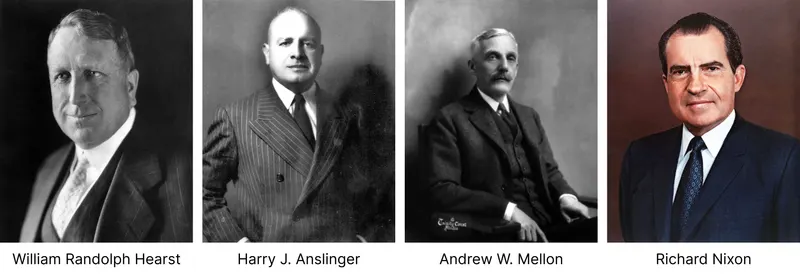
In the early 1900s, advances in hemp processing machinery led to a rapid rise in hemp products. This greatly troubled DuPont, which had recently invested in synthetic fibers. DuPont also manufactured chemicals used to turn wood into paper. Naturally, DuPont’s money was managed by Mellon Bank, whose owner Andrew W. Mellon was similarly concerned. In later years, Mellon would influence prohibition through Harry J. Anslinger, his niece's husband. It all began with William Randolph Hearst's propaganda unfairly demonizing cannabis.
William Randolph Hearst
William Randolph Hearst was one of America's largest publishers in the 1920s. He had also bought an enormous tract of land and invested heavily in producing paper from trees. Hemp paper's higher quality and greater productivity thanks to its short harvest cycle did not please Hearst. Knowing that hemp posed a serious threat to his business and industry, he began publishing anti-cannabis propaganda to discourage production.
Considering that this money-obsessed liar was a huge media owner, we can imagine how effective the propaganda was.
To demonize cannabis, Hearst first popularized the word “marihuana.” He then began smearing cannabis by creating the impression that all varieties were the same. He tried everything in this propaganda campaign.
Propaganda
Hearst did not hesitate to publish fabricated stories of every kind. These false stories, whose effects persist today, ranged from claims about Black musicians raping white women after smoking cannabis to claims that cannabis caused accidents.
One example was a report about a car crash in which a cannabis cigarette was found. The story remained on front pages for weeks, while alcohol-related accidents were relegated to the back pages despite being 10,000 times more common.
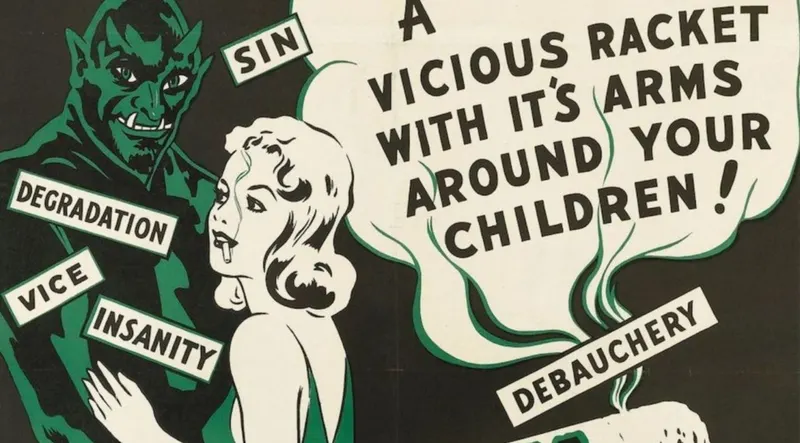
Another example is this absurd headline from Hearst's newspaper: “If the ugly monster Frankenstein encountered the monster marijuana, he would die of fright.”
Although industrial hemp has no psychoactive effect, people began viewing all cannabis varieties negatively.
Harry Jacob Anslinger
Years of propaganda came close to achieving their objective when Mellon and Anslinger became involved.
When Harry Jacob Anslinger became head of the narcotics bureau in 1930, opposition to cannabis became a political issue. Appointed by Treasury Secretary Andrew W. Mellon, his wife's uncle, Anslinger received a substantial $100,000 budget. Considering Mellon's concerns about hemp, it is easy to understand why his niece's husband Anslinger was so persistent on the subject.
While media propaganda continued, Anslinger began assembling cases to demonize cannabis.
The “Gore Files”
Anslinger used what he called the “Gore Files,” excerpts from police reports graphically depicting crimes attributed to drug users. These files relied on stories claiming links between cannabis and various crimes. The dossier of short police-report summaries would later be found to be entirely fabricated.
The most famous case was the story of Victor Licata, who killed his family. The story appeared in newspapers for weeks:
An entire family in Florida was killed by a young man. When officers arrived, they found the killer dazed amid a human slaughterhouse. Victor Licata had killed his father, mother, two brothers and sister with an axe. He appeared confused and did not remember what he had done. Officers knew him as a normally sane and rather quiet young man; now he was pitifully deranged. They looked for a cause. The youth said he had a habit of smoking marijuana cigarettes, which his friends called “muggle.”
The story was one of 200 violent crimes documented in Anslinger's “Gore Files.” It was later established that Licata killed his family because of severe mental illness, rather than cannabis use.
Researchers demonstrated that Anslinger falsely linked 198 of the stories in the “Gore Files” to cannabis, while the other two could not be assessed because no records of those crimes existed. In other words, attempts had been made to link every case to cannabis through fabricated evidence.
In testimony before Congress, Anslinger said more families would suffer unless cannabis was banned. With media and public pressure behind him, he succeeded, despite opposing views, in securing passage of the 1937 cannabis law, partially rather than completely banning it.
Although this appeared on paper to be a partial ban, heavy penalties on growers and the negative public perception brought hemp production close to extinction.
Note: Persuading the US government was not easy for Anslinger. Although scientists opposing prohibition presented considerable evidence, media influence and public pressure pushed the government to ban cannabis.
Hemp for victory!
The United States suffered a major blow with the attack on Pearl Harbor as it entered World War II. With the government unwilling to rely on imported fibers after war began, it recognized the importance of hemp production and temporarily relaxed the bans.
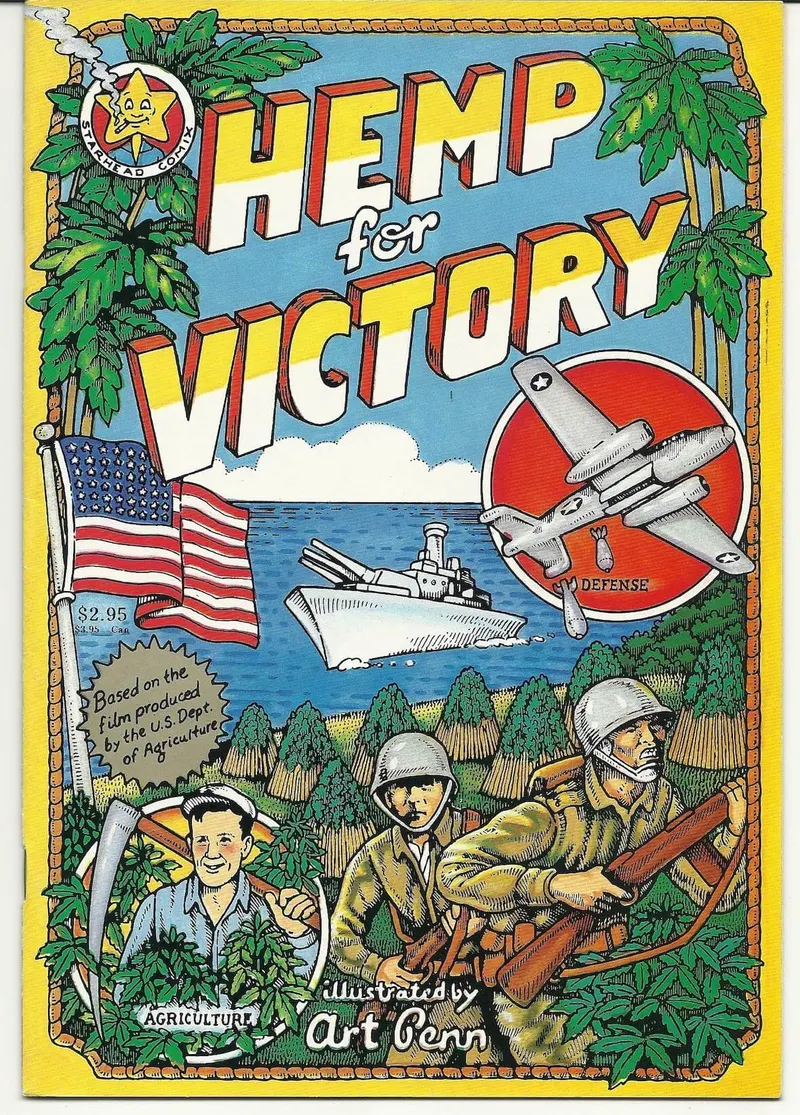
The “Hemp for Victory” campaign began to encourage farmers. Although hemp did not regain its former position, American farmers produced the ropes used in the war.
Richard Nixon
Despite the severe blow to the hemp industry, small enterprises kept it alive. Recreational cannabis use was also not treated as a crime carrying a penalty, according to this account. Until Nixon became US president!
Nixon, president from 1969 to 1974, built his strategy around the war on drugs.
Seeking scientific support, Nixon established the Shafer Commission of scientists in 1971. Saying “I want strong evidence to eradicate marijuana,” Nixon had high hopes for its 1972 report. Instead, the commission recommended against prohibition, stating that “It is less harmful than alcohol and, considering its health benefits, there is no need to ban it.” Furious, Nixon ignored the recommendation.
One of Nixon's senior aides, John Ehrlichman, later made this admission about the period: “Do you want to know what this was really about? In 1968 the White House had two enemies: the antiwar left and Black people. You understand what I mean. We knew we could not make opposition to the war or being Black illegal, but by associating hippies with cannabis and Black people with heroin, and criminalizing both heavily, we could manipulate the public. We could arrest their leaders, raid their homes, break up their meetings and vilify them at every opportunity. Did we know we were lying about drugs? Of course!”
Finally, Nixon's ally Attorney General John Mitchell completely banned cannabis by placing it in Schedule I in 1972, according to this historical account.
The truth always comes out
Cannabis, banned because of lies invented by a few greedy business owners and bad politicians, is now being legalized just as quickly. Interestingly, the United States, the country responsible for prohibition, is now among those leading the fight for legalization.


