
Note: This article was compiled from Deniz AKPINAR and Ahmet NİZAMOĞLU's article “Hemp Production from the Ottoman Empire to the Republic,” published in Turkish Studies – Social Sciences. We recommend reading their work for detailed information.
In the early Republic, global hemp production was about 750,000 tonnes: 500,000 in Soviet Russia and 125,000 in Italy. Turkey ranked tenth with 10,000 tonnes. Its largest hemp-growing regions by area were, in order, Kastamonu, İzmir, Samsun, Ordu, Zonguldak and Urfa.
Including 10,000 hectares in various other regions, Turkey had 40,000 hectares of hemp land in total. Early Republican hemp varieties could rival those of Italy, then considered the best producer (Kastamonu Yearbook, 1938, p. 107).
During 1924 Trade Ministry budget debates, Kastamonu deputy Halid Bey drew attention to hemp grown in central Kastamonu and Taşköprü. Emphasizing its importance for sacks and bags, he said Kastamonu produced one million kilograms annually but lacked a factory, making production expensive. He asked the trade minister for a hemp factory to compete with foreign hemp. His motion received no response (Kaş, 2011, pp. 340–342).
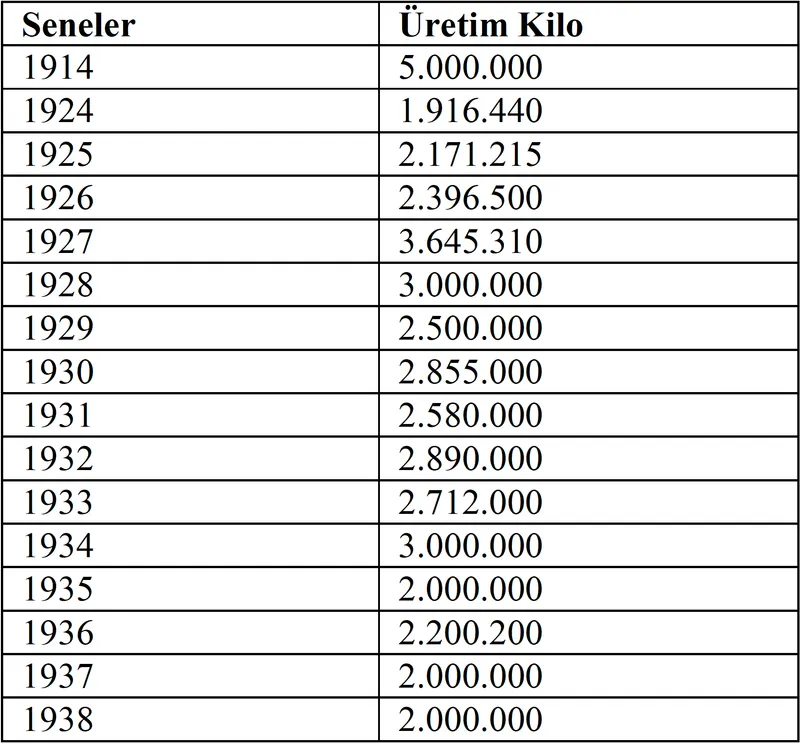
Raw hemp produced in Kastamonu Province, 1914–1938
Before World War I, hemp production approached seven million kilograms but gradually declined afterward. Reports from the 1930 Industrial Congress stated that production centered on Kastamonu Province and its surroundings. Approximately 600 rope- and twine-making workshops supplied domestic markets and exported to Europe. Given the advanced local industry, numerous craftspeople and skilled female workers, a cooperative and factories for rope, twine and sacks were proposed to compete with Italian goods.
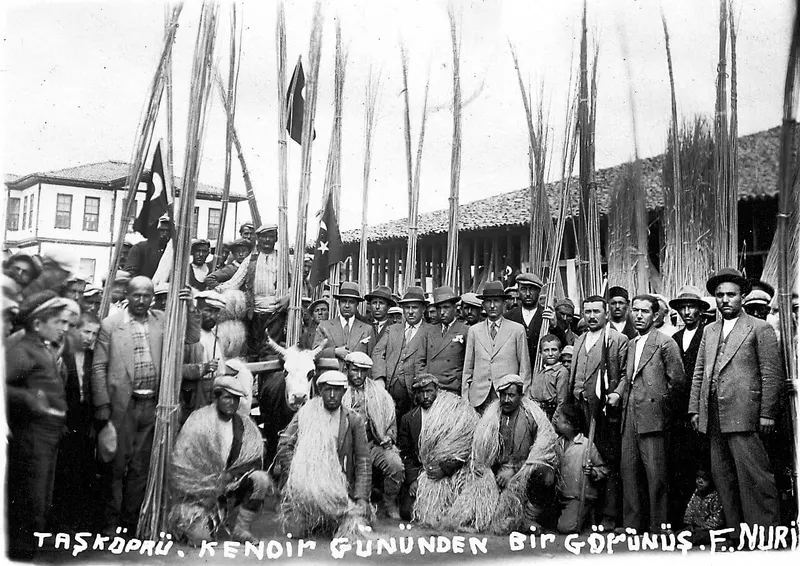
A photograph from Hemp Day celebrations in Taşköprü in the 1930s.
In 1932, Soviet experts visiting under the First Five-Year Industrial Program recommended six hemp processing plants and two factories to produce 9,800 tonnes of rope, thread, fine cord, sacks and packaging fabric.
Flax and hemp expert M. Golovin, who came to Istanbul with Professor Orlof, conducted investigations in Kastamonu. He considered Turkish flax and hemp excellent and said production should increase. With greater production, Turkey could cease importing and begin exporting these crops.

Raw hemp exported from Kastamonu to Europe, 1928–1933 (Öğütcü, p. 22).
A 1939 Ministry of Agriculture publication assessed hemp as follows: production had so far met only needs such as thread and rope, but a more developed weaving industry could domestically produce imported goods such as coverings, tent canvas and hoses. This would increase hemp's value and cultivation area. Growing regions were listed as follows (Flax–Hemp, 1939, pp. 3–4):
- Kastamonu: The largest region, averaging 3,000 tonnes annually, with cultivation in the central district and Taşköprü.
- Tire and Ödemiş: Annual production of 1,000 tonnes.
- Amasya: An annual average of 500 tonnes in Gümüşhacıköy district.
- Small-scale production also occurred in Urfa, Isparta, Edirne and Bursa.
Problems requiring attention were listed as follows (Flax–Hemp, 1939, p. 12):
- Use good seed.
- Sow more densely and regularly.
- Irrigate fields with greater control and correct timing.
- Determine the best harvest time.
- Build large and small retting pools and soaking pits.
- Conduct soaking under expert supervision.
- Use machinery where production is high or labor costs are expensive.
The outbreak of World War II delayed the planned Kastamonu hemp factory. Its foundation was laid in 1942, and Sümerbank completed the Kastamonu Taşköprü Hemp Factory in 1947 after the Council of Ministers adopted the “1945–1947 Urgent Economic Plan” on August 2, 1945.


