
Although many people think hemp is a new discovery following recent government announcements, the plant's history goes back a very long way. Hemp was extremely important to both the military and society in the Ottoman Empire, but technological development and economic factors have caused it to be forgotten today. We hope the government's steps take the right direction and revive this sector.
Note: This article was compiled from Deniz AKPINAR and Ahmet NİZAMOĞLU's article “Hemp Production from the Ottoman Empire to the Republic,” published in Turkish Studies – Social Sciences, and Mehmet Taşdemir's article “Hemp and Flax Production and Their Uses in the Black Sea Region (Late 15th Century to the First Half of the 17th Century),” published in Türk Kültürü İncelemeleri Dergisi. We recommend reading these articles for detailed information.
Hemp production in the Ottoman Empire
The Scythians brought hemp to Western Asia and Egypt between 2000 and 1000 BC, and to Europe around 1500 BC. Cultivation later began along the Mediterranean coast. Records also indicate hemp fibers in Anatolia dating to 800–700 BC. Hemp became an important European fiber crop from AD 500 and was widely used in the Americas from 1632.
In the plant's global circulation, the Chinese used hemp for paper around 100 BC and for textiles in 4200 BC. According to Herodotus, writing around 450 BC, the Scythians used hemp for weaving and making the tents in which they sheltered at night. Around 1150, Muslims introduced hemp to many parts of Europe. The continent's first map was drawn on hemp paper. In 1450, Gutenberg reproduced the Bible on hemp pages. In 1492, Christopher Columbus's ship was equipped with 80 tonnes of hemp sails and rope. Once the plant's importance became clear, its cultivation spread rapidly.
The Latin name for hemp was “Kanbis sativa”; Greeks called it “Kanavis,” the Portuguese “Kanhamo,” the Spanish “Kanamo,” Russians “Kanaple,” Poles “Kanap,” Hungarians “Kender,” Arabs “Kınnup,” and Italians “Kanapa.” In the Ottoman Empire it was called “Kendir” or “Kenevir.”
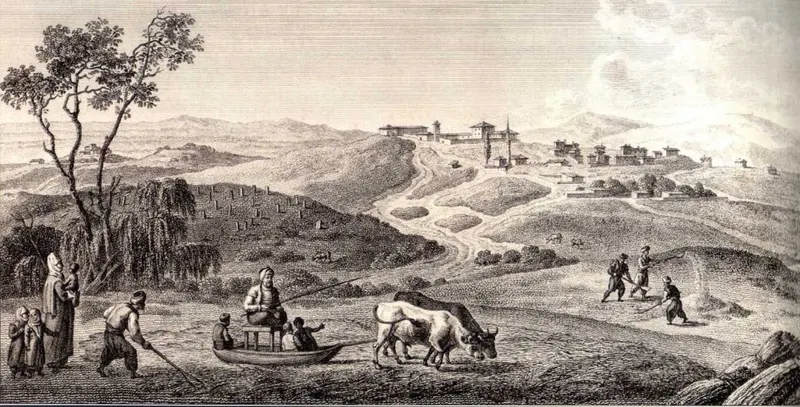
Farmers in the Ottoman era
When Barbaros Hayreddin Pasha, one of the admirals of the reign of Sultan Süleyman the Magnificent, served as grand admiral, the ships under his command obtained their cordage and ropes from hemp produced in Kastamonu.
The provinces prominent in Ottoman hemp production were Aydın, Trabzon, İzmir, Canik, Ordu and Kastamonu.
Hemp's importance to the Ottoman navy
From its classical period, the Ottoman state used hemp to make naval materials such as cords and ropes. It therefore placed particular importance on producing and procuring this indispensable material for the Imperial Arsenal, Tersane-i Amire. The districts and provinces of Trabzon, Ordu, Canik, Aydın, İzmir and Kastamonu were leading hemp producers. Kastamonu in particular remained the region with the greatest production from the Ottoman period into the Republic. At times, Kastamonu hemp was even exported to Europe.
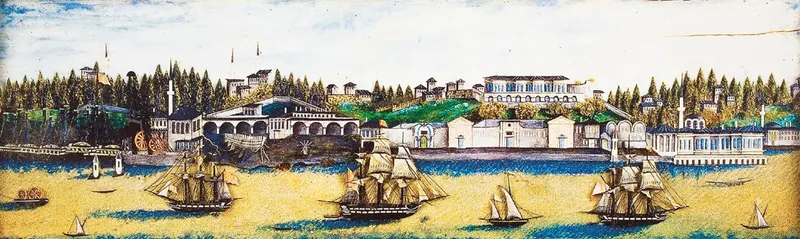
Events in Aydın illustrate the Ottoman state's emphasis on hemp production:
Deliveries of hemp from Aydın to the Imperial Arsenal were sometimes disrupted. The main reason was that some Muslim and non-Muslim merchants, instead of sending hemp to the arsenal as required, sold it to foreign traders through ships to make more profit. The state did not tolerate this. It declared that people who neglected the arsenal's needs or sold hemp while disregarding them would be punished. İzmir's leading figures and various merchant groups were specifically warned. This shows the importance the state attached to meeting its own hemp requirements first.
Regions where hemp was grown
From the early 19th century, the Ottoman Empire met its hemp requirements from Anatolian provinces and districts such as Aydın, Trabzon, İzmir, Canik, Ordu and Kastamonu.
Trabzon Province and its districts became particularly prominent in hemp production in the mid-19th century. In 1851, because the annual hemp allocations for the Imperial Arsenal from Canik and Ordu districts had not been collected for some time, the naval accounts office instructed Trabzon Province to procure all outstanding hemp yields from earlier years, including 1851. It was determined that Canik should send 18,342 kantars and Ordu 14,968 kantars. Since supplying all the Imperial Navy's equipment depended on hemp, and considerable equipment was needed, the hemp in those districts was requested immediately. Failure to collect it would disrupt the Imperial Arsenal's work. The governor of Trabzon was ordered to dispatch the hemp in installments as soon as possible.
Alongside Aydın, Trabzon, İzmir, Canik and Ordu, Kastamonu Province was an important hemp center from Ottoman times into the Republic's early years. From the mid-19th century, Kastamonu was a major center for hemp cultivation and rope manufacture. Its hemp and rope were exported to İstanbul and even Europe. The state generally procured its cords and ropes from Kastamonu.
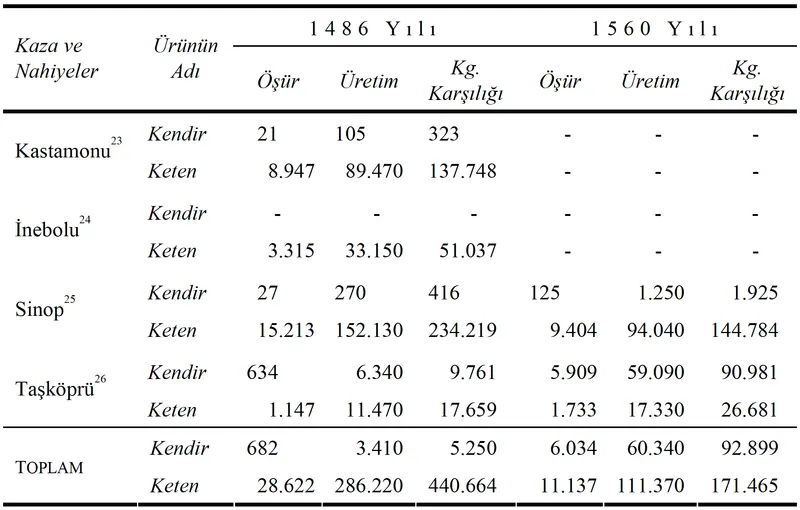
A table of hemp and flax production over approximately a century, from the late 15th to the late 16th century.
Uses of hemp in the Ottoman Empire
The many laborious processes after hemp harvesting required collective work. Once fibers were separated from the stalk, pounding began using various tools. The fibers were crushed and softened on a flat stone with wooden mallets. Their color lightened during this stage, after which they were combed. Combing aligned the fibers and prepared them for manufacture. Products made from processed hemp included:
Fine twine: kınnap
One of the finest products, this was made from the best fiber in two or three strands. There were five types: looped kınnap, braided kınnap, end kınnap, double kınnap and triple kınnap. These were an important source of livelihood. Such fine fibers were made in the Rize region and were indispensable income sources in the other settlements covered by the research. Ready for manufacture, the material was used for summer dresses, nightwear, bed and quilt sheets, and headscarves. Yarn from these fine fibers was also used for awnings, fishing nets, sacks, carpet warp, tents and tarpaulins. Its resistance to seawater made it particularly desirable for maritime materials.
Twine: sicim
Thicker than kınnap, this came in varieties including argalya (fine and coarse), franya (whip franya, four-whip franya, Thessaloniki franya and braiding franya), market twine and waist cord.
Rope: urgan
This was the product with the widest range of uses, employed extensively for tying, knotting, wrapping, packing, fastening and baling. Its production involved a broad section of society, from growing and processing the raw hemp to manufacture and marketing. Ropes were made either ready for sale or to order. Custom ropes were made to the buyer's desired dimensions and length, while ready-made ropes followed standard sizes. Like other trades, rope makers had a guild organization, with officials such as a kethüda, nakib, şeyh and yiğitbaşı. No maker could use defective strands. Those who produced substandard goods were publicly exposed, humiliated and barred from the trade.
Like twines, ropes were made in various sizes and lengths. These were called yarımlık, üçyüzlük, okkalık, beşyüzlük, birbuçukluk, ikilik and ikibuçukluk.
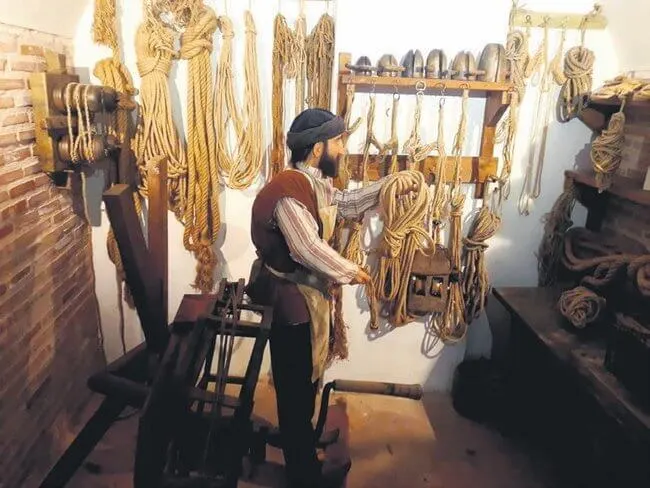
A representation of a rope-making artisan (Tokat Municipality City Museum)
Heavy rope: halat
Thicker than urgan, these ropes weighed between 5 and 50 kg. They were generally made to order. Although there were no fixed types, they were made to the customer's requirements, mainly for ships and the navy. They could reach 100 meters in length.
Foreign entrepreneurs
In the early 20th century, hemp concessions attracted initiatives from foreign entrepreneurs and companies as well as domestic ones. A large Hungarian company involved in hemp cultivation and trade sought to grow hemp near Konya and Ereğli. It was prepared to buy or rent about 10,000 hectares with running water or wells suitable for irrigation, and later wished to establish a large hemp factory there.
Cover image: Ottoman Archive


