
One of the first decisions a farmer wishing to grow industrial hemp must make is which type to cultivate. Establishing its purpose is essential. Each type requires different seed varieties, equipment and techniques. Land and labor requirements, weed management and pest control also vary.
We can group industrial hemp into three main categories:
- For fiber production
- For grain or seed production
- For CBD production
The most popular industrial hemp varieties worldwide are currently those grown for CBD. Why? Because CBD products have become one of the most popular health trends in recent years, and the rapidly growing CBD industry is projected to be worth $22 billion by 2022.
Unfortunately, Türkiye has yet to take steps toward producing CBD and its by-products. With special permission, industrial hemp can be grown in designated provinces using domestic seed, but extracting and selling CBD oil is prohibited.
Industrial hemp also has thousands of uses across many categories, so large quantities are grown worldwide for grain, seed and fiber beyond CBD. Let us discuss the general hemp morphology every grower should know and examine these types in more detail.
General industrial hemp morphology
- Hemp is a dicotyledonous plant with two cotyledon leaves.
- Hemp is dioecious: male and female flowers occur on separate plants. Monoecious forms also occur.
- The ratio of male to female plants is typically 1:1.
- Hemp is wind-pollinated. Pollination typically lasts 2–3 weeks, depending on weather conditions and uniformity.
- Only male hemp plants produce pollen.
- Male plants age and die after shedding all their pollen.
- Hemp is said to produce more pollen than any other cultivated crop. Hemp pollen can travel up to 15 km.
- Male plants are the first to show flowering signs, with staminate flowers appearing at their nodes.
- Flowering typically starts 4–6 weeks after sowing.
- Female plants can generally be identified 5–14 days after males.
Industrial hemp for fiber production
These plants are very slender and 3–5.5 meters tall. Varieties grown for fiber for many years have great potential for paper, fabrics, construction and various manufacturing operations.
- Sowing time: May to early June
- Planting method: Grain drill or broadcast seeder
- Sowing rate: 20–30 kg per dönüm
- Harvest time: During pollination, generally 45–70 days after sowing; mid-July to early August
- Harvest method: Mower (sickle or disc mower) and hay baler (round or large square)
- Postharvest handling: Left to dry to 15% moisture, then baled
- Other: Some varieties can also be harvested for seed, but special harvesting equipment may be needed
Industrial hemp for grain or seed production
These plants are slender and approximately 1.5–2 meters tall. They produce oilseed grains with high nutritional value and protein content. Hemp seeds are among the most nutritious foods available. Because the seeds are very delicate, harvesting, processing and transport require care. Storage is also very important to ensure the highest possible quality.
- Sowing time: Mid-May to mid-June
- Planting method: Grain drill, broadcast seeder or corn planter
- Sowing rate: 10–15 kg per dönüm
- Harvest time: Generally 100–120 days after sowing; September or mid-October
- Harvest method: Standard combine harvesting
- Postharvest handling: Cleaned and air-dried before storage in a grain bin
- Other: Some varieties can also be harvested for fiber after combining
Industrial hemp for CBD production
These cannabinoid-rich plants are grown and harvested for CBD (cannabidiol), which has many potential health applications. They can reach 2–4 meters in height and are very bushy.
Achieving the highest CBD levels while keeping THC below 0.3% requires some expertise. Typically, only female plants are used, because male plants reduce CBD levels and increase seed production.
- Planting time: Seedlings can be planted outdoors until mid-June, or year-round in greenhouse systems
- Planting method: By hand or using a transplanter
- Planting rate: 800–1,500 plants per dönüm, spaced 1.2–1.8 meters apart
- Harvest time: Near-mature female plants are harvested outdoors from mid-September to mid-October. Greenhouse harvest times may vary
- Harvest method: Plants are cut by hand and removed from the field
- Postharvest handling: Dried in drying sheds or storage areas according to their characteristics. Once dry, flowers and some leafy material are removed from the stalks, packaged and processed for oil extraction
- Other: Only female plants are used; male plants are destroyed once identified
Türkiye's domestic industrial hemp seeds: Narlı and Vezir
At a meeting on January 11, 2019, held under the policy of expanding industrial hemp production in Türkiye and supplying industry with domestically grown hemp raw material, it was decided to multiply seed from the domestic Narlısaray population until the registration and seed multiplication processes for the domestic candidate varieties Vezir and Narlı were completed.
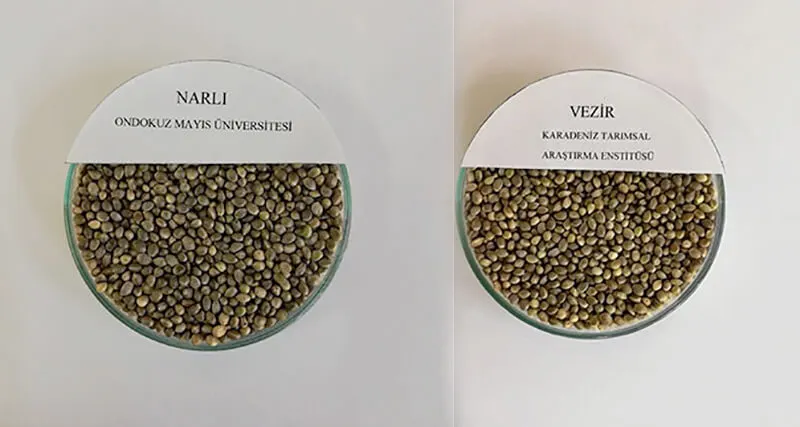
Our domestic seeds, Vezir and Narlı
If “Vezir” and “Narlı,” submitted to the Seed Certification Testing Directorate, are registered following the necessary research, they will become Türkiye's first domestic hemp seeds. However, although considerable time has passed since the latest decisions, there has been no updated announcement about registration of the seeds developed through five years of work by Samsun Ondokuz Mayıs University (OMÜ) and the Black Sea Agricultural Research Institute Directorate. Their industrial hemp category and cannabinoid content are also unclear.
It is deeply disappointing that Türkiye is falling behind in this important economic field while many countries process industrial hemp, a market with multibillion-dollar potential, and sell by-products including CBD globally. We hope our country takes the necessary steps quickly to claim its share of this rapidly growing industry and join the leading countries.


